
See scrap before the customer calls.
Solution 03 · Quality moduleChecks happen during production instead of after it. The operator gets a signal at the first deviation, not at the five thousandth.
From checking afterwards to stepping in during the run.
- Checks live on a sheet that gets filled in afterwards.
- A bad run reaches you through a customer complaint.
- Who took the measurement, and when, can no longer be traced.
- The operator enters the check on the screen, tolerance included.
- Out of tolerance, and a signal appears at the line straight away.
- Every measurement stays linked to order, machine and operator.
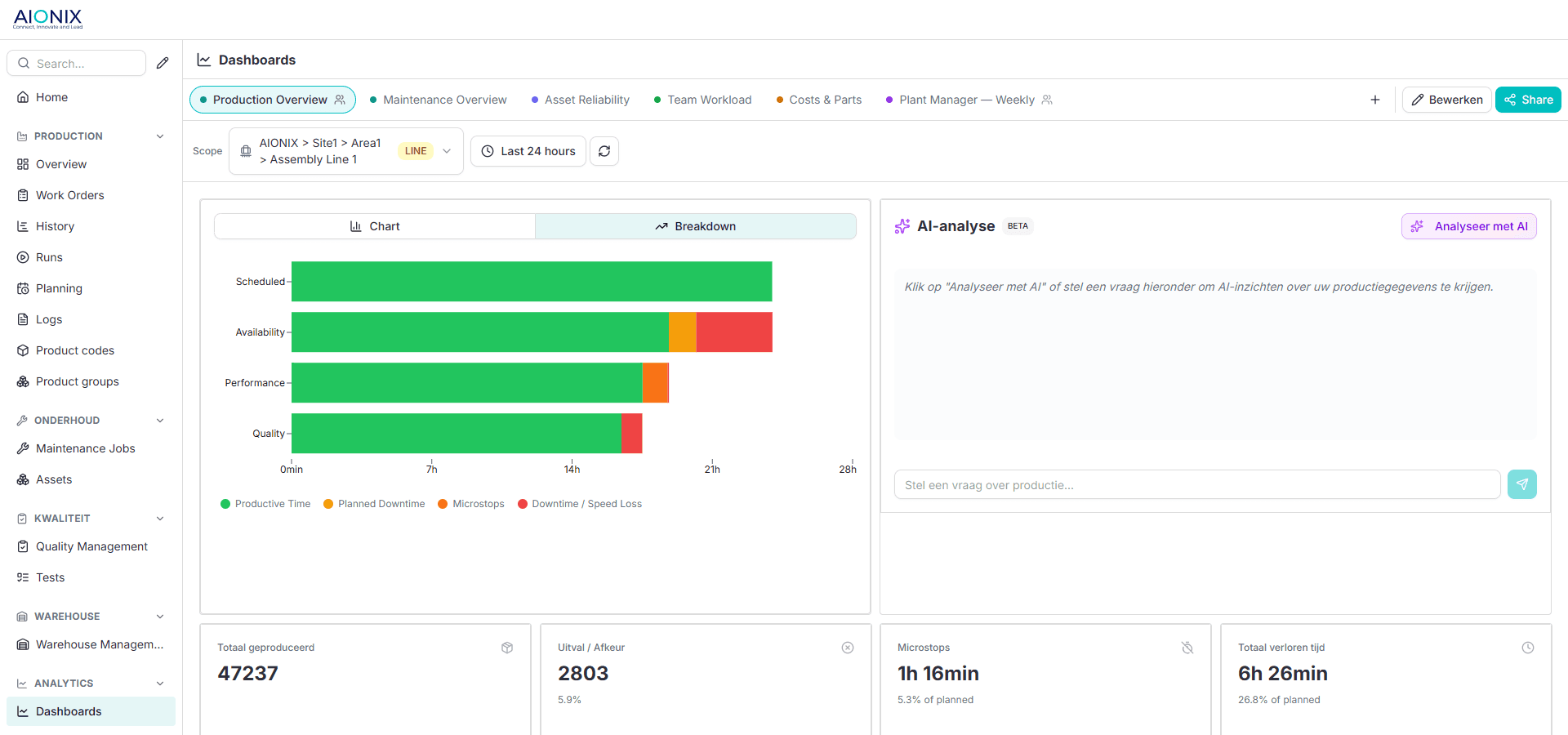
This is how it looks in the AIONIX portal.
Capture, signal, prove.
Capture
We put your check lists on the screen at the line: which measurement, how often, which tolerance.
Signal
If a value falls outside tolerance, the operator sees it immediately and the run stops there.
Prove
Everything is registered per order. On a complaint or audit you pull it up in one click.
What a check on the floor looks like.
A measurement plan defines, per product group, what gets measured, how often, and what happens when a value falls outside. These are the kinds of rule that end up on the screen at the line.
| Measurement | When | On a deviation |
|---|---|---|
| First piece | At every changeover, before the run is released | The run does not start. The operator sees which value is out of tolerance |
| Sample | Every set number of pieces, or every hour | A signal at the line and a second measurement to confirm |
| Visual check | Continuous, or at a set interval | The defect type is recorded, so you can see later which type keeps coming back |
| Last piece | When the order is closed | The order cannot be reported complete while the measurement is missing |
| Customer-specific check | Only on the product groups where the customer asks for it | Hangs on the order, so you can show it on a complaint |
The frequencies and tolerances come from your own quality manual. We put them on the screen; what has to be measured stays your decision.
The same measurement, four different decisions.
Measures on the screen
The check list sits at the line, with the tolerance beside it. Out of tolerance shows immediately, not at the final inspection.
Sees the pattern
Which product group, which machine, which shift. A deviation that keeps coming back is a different problem from a one-off.
Knows whether to step in
The measurement hangs on the order and the machine, so you can see whether it was the batch or the line itself.
Has an answer that holds up
On a complaint you show the measurements behind that order instead of digging through a folder.
Four questions about quality registration.
Does this replace our quality manual?
Our operators work from check sheets. What changes for them?
Can we set our own measurement plans and tolerances?
What can we show at an audit or on a customer complaint?
What quality gains from the rest.
Quality is one module of the MOM platform. A measurement on its own is a number; with the context around it you know where it came from.
Production monitoring
Without production context a deviation is a loose data point. Together it hangs on the order, the machine and the shift that was running, so you can see whether it was the batch or the line.
Traceability
On a complaint the question isn't whether there was scrap, but which batches it touched. Add traceability and you walk from measurement to batch to customer instead of through your archive.
Maintenance
Scrap that climbs slowly is often a machine drifting out of tolerance. Together you can see whether an intervention brought quality back, and whether you waited too long.
To see checks during production running on a real line, read how Depro Profiles inspects 40,000 panels a day on both sides. How increasingly complex production stays manageable is covered in complex manufacturing.
Put your entire shop floor on the same platform.
No 'big bang'. As a West Flanders-based team, we start at your SME with the first module on the first line, prove the value, and build out together to your full platform, at the pace and budget of an SME.